Most enterprise AI projects fail between Month 3 and Month 6 because organizations hit a predictable productivity decline — the J-Curve — and executives panic before the investment has time to pay off. The dip isn’t a sign that the technology is broken. It’s the documented cost of organizational transformation, and the firms that plan for it are the ones that survive.
This is the pattern no one tells you about during the vendor demo.
The Dip That Kills Careers
Picture your star claims processor. Month 1, she’s thrilled with the AI demo — it nailed three test cases in the boardroom and she’s imagining what her team could do. Month 4, she’s double-keying everything — running the AI’s output against her manual work, correcting mistakes the demo never made — and her throughput is down 30%.
Your Board wants answers. She wants her old workflow back.
If you’ve led enterprise transformation before, you’ve seen every beat of this story. The enthusiasm at kickoff. The confident projections. The budget approvals. Then, three months in, productivity tanks, users are frustrated, and the CFO is drafting termination memos.
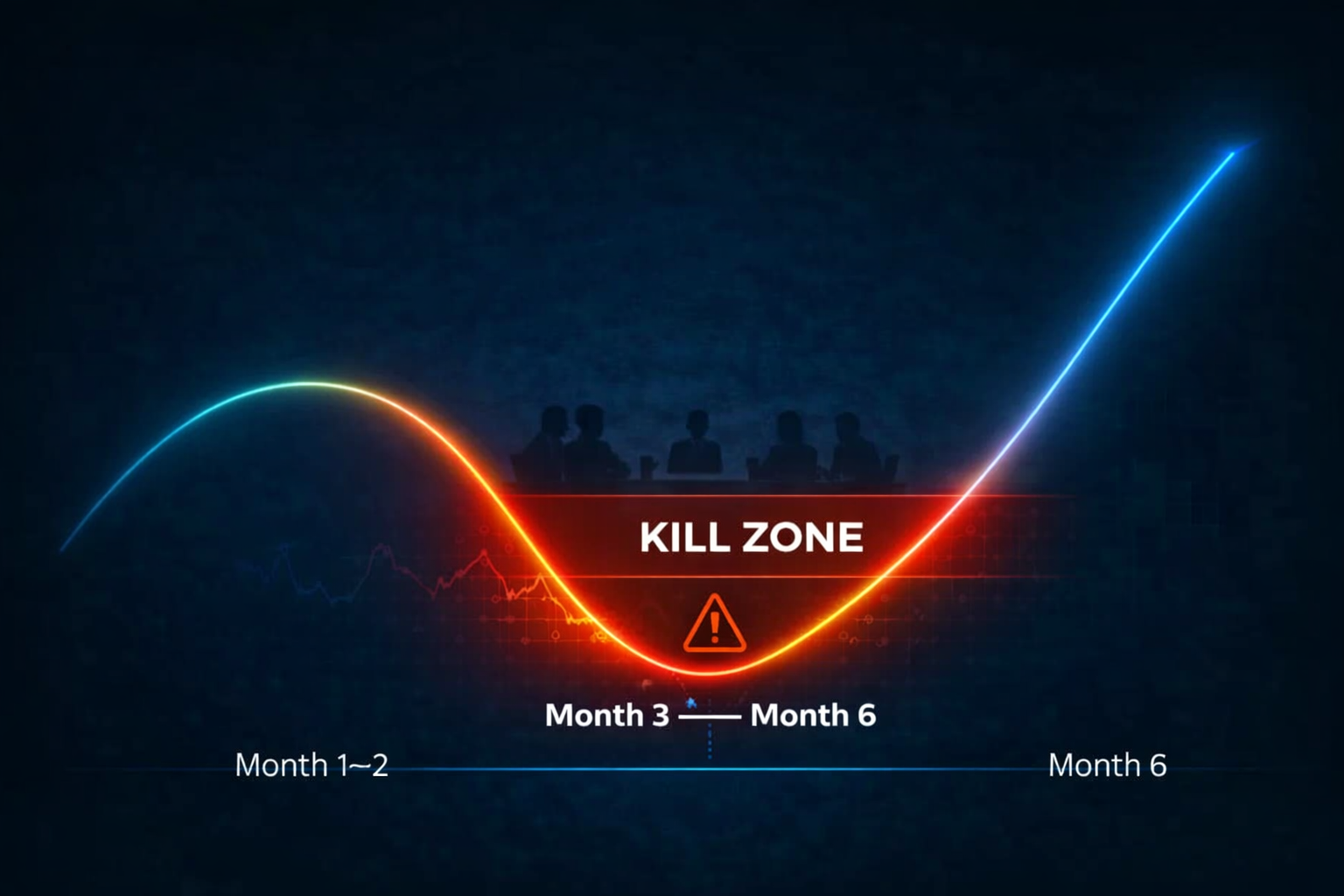
Plot productivity over time and the shape is unmistakable: sharp drop, painful trough, eventual recovery. It looks like the letter J. That’s the J-Curve.
The Research Is Damning
In 2025, researchers from MIT, the University of Colorado Boulder, the U.S. Census Bureau, and Stanford published the most comprehensive study to date on AI’s productivity effects. Analyzing data from tens of thousands of U.S. manufacturing firms between 2017 and 2021, they found that AI adoption reduced productivity by an average of 1.33 percentage points in the short term.
That’s the average. When corrected for selection bias — accounting for the fact that firms expecting higher returns are more likely to adopt early — the short-run negative impact reached up to 60 percentage points for the most ambitious adopters. The firms that pushed through eventually outperformed their non-adopting peers — but only after four or more years of sustained investment.
This pattern isn’t new. Stanford economist Erik Brynjolfsson documented it across general purpose technologies going back a century. When factories installed electric motors in the early 1900s, they kept their old layouts designed for steam power. It took decades and complete factory redesigns before productivity jumped. The same thing happened with computers in the 1980s. It’s happening now with AI.
The mechanism is always the same: transformative technologies require massive investments in intangible assets — training, process redesign, organizational restructuring — that don’t show up in productivity statistics until years later. Brynjolfsson and colleagues estimated that adjusting for these intangible investments yields true productivity levels nearly 16% higher than official statistics suggest. The work happening in the trough is creating real value. It just doesn’t show up in the numbers yet.
Why the Demo Lied to You
In February 2026, Princeton researchers tested 14 AI models from OpenAI, Google, and Anthropic across 500 benchmark runs and found something every executive needs to understand: 18 months of rapid capability gains produced only modest reliability improvements, with consistency scores ranging from 30% to 75%.
Demos test capability. Production tests reliability.
That gap — between what AI does in a controlled showcase and what it does when your team runs it against real workflows with messy data and edge cases — is the J-Curve’s technical mechanism. Your vendor showed you the highlight reel. Production is the regular season, played on bad fields, in bad weather, with the backup quarterback.
This is why the boardroom demo is so dangerous. It creates an expectation of performance that production can’t match — not because your team is doing something wrong, but because reliability lags capability by a wide margin. When your claims processor encounters the AI confidently producing wrong answers on the cases that don’t look like the demo, trust collapses. And trust, once broken, is the hardest thing to rebuild.
The Kill Zone
Months 3 through 6 is the Kill Zone. This is when the productivity dip bottoms out, executive patience runs thin, and programs get canceled.
The psychology is brutal. Your team is doing more work, not less — they’re double-keying, running manual processes alongside AI processes, catching errors, rebuilding trust in outputs they don’t yet understand. Workload increases roughly 1.5x before it starts decreasing. That’s Double-Keying: the invisible labor that makes the numbers look terrible even when learning is happening.
Most companies don’t survive the Kill Zone. Not because the technology fails, but because the executives lose their nerve when quarterly numbers decline and the Board demands answers. The six-month pilot is the most dangerous structure in enterprise AI — the budget runs out right when breakeven would arrive.
What the Survivors Do Differently
The firms that make it through share three things in common.
They lock in 18 months of protected funding before deployment starts. Not 6 months. Not 12. Eighteen. Because the J-Curve research is clear: the trough lasts 9 to 12 months, and the real gains don’t materialize until Month 18 to 24. Starting a pilot with six months of runway is like packing a two-hour oxygen tank for a six-hour dive. The MIT and Census Bureau data is unambiguous on this: older, more established firms experienced significantly larger short-term losses. If you’re a large enterprise in a regulated industry, the trough will be deeper and longer than the average. Plan accordingly.
They track learning metrics during the trough, not ROI. Squad certification rates, error rate trends, usage patterns — these are the leading indicators that prove the investment is working before the lagging indicators catch up. If you’re measuring ROI at Month 4, you’re measuring the wrong thing at the wrong time, and you’ll make the wrong decision because of it.
And they communicate relentlessly. Before the dip arrives, they get it on the record: “Based on MIT and Census Bureau research, we expect productivity to decline in the short term. This is normal, expected, and documented.” When Month 4 arrives and the CFO wants answers, they pull out that presentation and say: “As predicted.” The difference between a crisis and a milestone is whether you told the Board it was coming.
The Gap Is Already Widening
Data from the InvestOps 2026 survey of 200 global buy-side leaders shows the separation happening now. After two consecutive years prioritizing operational efficiency, 55% of firms have shifted their top priority to competitive differentiation through innovation. Portfolio management and trading innovation jumped from 32% to 56% in a single year.
NVIDIA’s 2026 survey of financial services institutions tells the same story from the other side: 52% of firms that pushed through cite operational efficiency gains, and 48% report boosted employee productivity — that second number more than doubled from 22% the prior year.
The firms that survived their J-Curve 18 to 24 months ago aren’t just more efficient. They’re building products competitors can’t match. The firms still stuck in the trough are falling behind at an accelerating rate.
The J-Curve isn’t a temporary inconvenience. It’s a permanent sorting mechanism.
What You Can Do Monday Morning
First, stop any AI pilot built on a six-month timeline. It will die in the Kill Zone. Either extend it to 18 months with protected funding, or don’t start.
Second, build the Month 0 presentation before deployment begins. Get the productivity dip on the record with your Board. When the dip arrives — and it will — you want to be pointing back to a prediction, not making an apology.
Third, change what you measure. During the trough, track learning: certification completion, error rate trends, workflow adoption. ROI comes later. If learning happens, ROI follows.
The full survival playbook — including the communication scripts for Month 0, Month 4, and Month 10, and the framework for building Stepping Stone Projects that create political cover during the Kill Zone — is in Chapter 2 of Flatten the AI J-Curve.
The Don’t Panic scripts are available as free downloads at flattenthej.com.
∗ ∗ ∗
This article is adapted from Chapter 2 of Flatten the AI J-Curve: Your Unfair Advantage in the Race to Enterprise Adoption, available May 5, 2026.
Subscribe to The Signal | flattenthej.com | Available May 5, 2026